Understanding Weak Espresso
An espresso machine making weak coffee is a common frustration, signaling that your extraction is not optimal. The resulting shot lacks body, crema, and the rich, concentrated flavor espresso is known for. This issue points to a lack of proper resistance during the brewing process. Water flows through the coffee grounds too quickly, failing to extract enough soluble compounds.
Several factors contribute to weak espresso. The most frequent culprits are an incorrect grind size, inconsistent tamping, or stale coffee beans. Machine malfunctions, such as low pump pressure or clogs, can also play a role. Diagnosing the problem involves a systematic check of your preparation steps and your equipment. Identifying the precise cause allows for targeted adjustments, bringing back those robust, flavorful shots.
Incorrect Grind Size
The grind size of your coffee beans is perhaps the most critical variable in espresso extraction. Espresso requires a very fine grind, finer than for drip coffee or pour over. If your grind is too coarse, water passes through the coffee puck too easily and too quickly. This results in under-extraction, leading to a weak, watery, and often sour-tasting shot.
How to Diagnose Grind Size Issues
Visual Inspection: Look at your ground coffee. It should feel like finely powdered sugar or flour, not grainy like table salt. If you see distinct particles, it is likely too coarse.
Shot Time Test: Pull a shot of espresso. For a standard double shot (approximately 1.5 to 2 ounces), the extraction time should be between 25 and 30 seconds. If your shot pours much faster than 25 seconds, your grind is too coarse. The stream will appear thin and blond very quickly.
Taste Test: Under-extracted espresso tastes sour, acidic, and lacks body. It will feel thin on your palate.
Solutions and Costs
Adjust your grinder to a finer setting. Make small adjustments, typically one or two clicks at a time on a stepped grinder, or a tiny turn on a stepless model. Pull another shot and observe the changes in shot time and taste. Repeat this process until you achieve the desired extraction.
If you are using a blade grinder, consider upgrading to a burr grinder. Blade grinders chop beans inconsistently, creating an uneven particle size that makes proper espresso extraction almost impossible. A quality burr grinder, whether conical or flat, provides a consistent and precise grind. Entry-level burr grinders start around $100, with more advanced models costing $200 to $400 or more. The cost for adjusting your existing burr grinder is $0.
For users of specific machines, troubleshooting grinding issues might involve specific adjustments. If your Breville Barista Express is grinding too coarse, explore these fixes and adjustments.
Inconsistent or Insufficient Tamping
Tamping is the process of compressing the ground coffee into a compact, level puck within the portafilter. Proper tamping creates resistance against the pressurized water, making sure it flows evenly through the coffee bed. If your tamping is too light, uneven, or inconsistent, water will find paths of least resistance, leading to channeling. This means water rushes through gaps in the puck, under-extracting parts of the coffee and resulting in a weak shot.
How to Diagnose Tamping Issues
Puck Inspection: After pulling a shot, remove the portafilter and inspect the spent coffee puck. A properly tamped puck should be firm, relatively dry, and intact. If it is muddy, crumbly, or has visible holes or cracks, this indicates channeling due to poor tamping.
Shot Observation: Watch the espresso stream as it exits the portafilter. It should emerge as a steady, even flow from all spouts (for a double portafilter). If you see streams squirting unevenly or channeling from one side, tamping is likely the culprit.
Consistency Check: If some shots are good but others are weak, your tamping technique may be inconsistent from shot to shot.
Solutions and Costs
Focus on developing a consistent tamping technique. Apply firm, even pressure. Make sure the puck is level. Many baristas use a tamping mat to help achieve stability and protect their countertops. Practice is key here, and the cost for improving your technique is $0.
For enhanced consistency, consider a calibrated or self-leveling tamper. These tools help apply a consistent amount of pressure every time or ensure a perfectly level tamp. They can significantly improve shot consistency, especially for beginners.
Recommended Tampers for Consistent Espresso
A high quality tamper can make a significant difference in your espresso preparation. Here are some top choices:
51mm Espresso Tamper-Premium Barista Coffee Tamper
This classic series stainless steel tamper offers an exquisite appearance and ergonomic design. Its ideal size and weight contribute to effective espresso control. It is designed to fit all 51mm commercial espresso filter baskets. Ensuring it fits your specific machine's portafilter basket is important before purchasing. This tamper helps you apply consistent pressure for better extraction.

- Please check that this will fit your filter basket before purchasing.Fits all 51mm Commercial Espresso.
- The tamper has an exquisite appearance, Stainless steel design, the handles were ergonomically designed to.
- Due to the high quality of the steel espresso control, the tamper has an ideal size and weight, because of.
- The tamper is manufactured with an ergonomic and smooth solid wood handle for a comfortable and sturdy.
Normcore V4 Coffee Tamper 53.3mm
The Normcore V4 is a spring-loaded tamper engineered for consistent pressure every time. It comes with three interchangeable springs (15lb, 25lb, and 30lb) to match your preferred tamping force. Its self-leveling design guides you to keep the tamper perfectly aligned, reducing channeling issues. This 53.3mm size is common for many Breville espresso machines.

- CONSISTENT PRESSURE EVERY TIME:Achieve perfectly even tamping with a built-in spring-loaded mechanism.
- 3 INTERCHANGEABLE SPRINGS INCLUDED:Comes with 15lb, 25lb, and 30lb springs to match your preferred tamping.
- SELF-LEVELING DESIGN FOR PERFECT ALIGNMENT:Engineered with an integrated leveling guide to keep the tamper.
- PRECISION FIT FOR 54MM BREVILLE PORTAFILTERS:Specifically designed (53.3mm) to fit Breville / Sage.
51mm Espresso Tamper Espresso Accessories Kit
This premium package includes not just a 51mm tamper, but also a WDT tool, dosing funnel, and puck screen. All components are crafted for precision and durability, making cleaning easy. The espresso distribution tool, with its 6x0.4mm needle stirrer, helps break up clumps for an even coffee bed before tamping.

- Inside this premium package, you'll discover a 51mm tamper, wdt tool, dosing funnel, and puck screen,all.
- Crafted for precision and durability, easy to clean, ensuring even tamping for consistent extraction and.
- Espresso distribution tool is tested by professional baristas, our 6*0.4mm needle stirrer effortlessly.
- Crafted for espresso preparation, this 51mm magnetic dosing funnel securely attaches to portafilters with.
A good tamper generally costs between $20 and $100. Investing in a quality tamper can eliminate a major variable in weak espresso. Learn more about the purpose of a coffee tamper and why it matters.
Stale Coffee Beans
Coffee beans are perishable. After roasting, they begin to degas and lose their volatile aromatic compounds. Using stale beans will almost always result in a weak, flat-tasting espresso shot with very little crema.
How to Diagnose Stale Beans
Roast Date Check: Always check the roast date on your coffee bag. For optimal espresso, beans should be used within 2-4 weeks of their roast date. If there is no roast date, or if it is older than a month, the beans are likely stale.
Aroma Test: Freshly roasted coffee has a vibrant, strong aroma. Stale beans will smell dull, muted, or almost scentless.
Crema Observation: A hallmark of good espresso is a rich, reddish-brown crema. Stale beans produce minimal crema, or crema that dissipates very quickly after the shot is pulled.
Solutions and Costs
The solution is simple: use fresh, high quality coffee beans. Purchase beans from a reputable roaster and buy smaller quantities more frequently to ensure freshness. Store them in an airtight container, away from light, heat, and moisture. The cost here is simply the regular price of fresh coffee beans, typically $15-$25 per 12-ounce bag.
Machine Issues: Pressure, Temperature, and Clogging
Even with perfect grind and tamping, your espresso can still be weak if the machine itself is not performing correctly. Issues with pump pressure, water temperature, or internal clogs can all hinder proper extraction.
Low Pump Pressure
Espresso machines operate at high pressure, typically around 9 bars, to force water through the finely ground coffee. If the pump pressure is too low, water will not extract coffee efficiently, leading to weak and under-extracted shots. Low pressure can be caused by a failing pump, scale buildup, or a leak in the system.
How to Diagnose Low Pump Pressure
Shot Volume and Flow Rate: If your machine struggles to produce the correct volume of water, or if the water flows very slowly even without a portafilter, this suggests a pressure problem. Conversely, if water flows through the portafilter too easily despite a fine grind and good tamp, pressure might be insufficient.
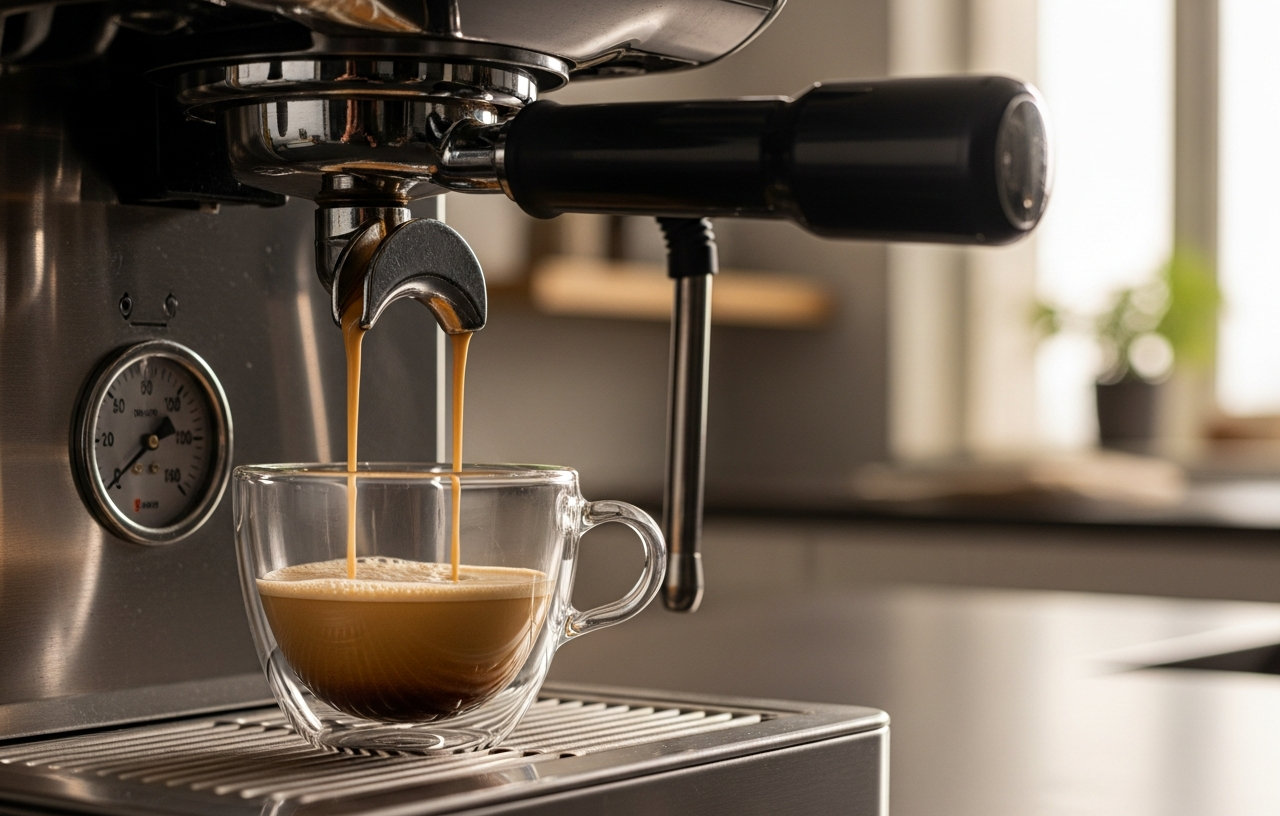
Machine Noises: A pump that sounds weak or strained, or one that makes unusual noises, might be failing. Some machines have a pressure gauge; if yours does, observe it during extraction. It should ideally read around 9 bars.
Solutions and Costs
- Descaling: Mineral buildup (scale) can restrict water flow and reduce pump efficiency. Regularly descale your machine according to the manufacturer's instructions, typically every 1-3 months depending on water hardness. Descaling solutions cost $10-$20.
- Check for Leaks: Inspect your machine for any visible water leaks. A leak can cause a drop in pressure.
- Pump Replacement: If descaling does not resolve the issue and no leaks are present, the pump itself might be failing. Replacing a pump can be a DIY project for mechanically inclined individuals, costing $50-$150 for a new pump. Professional repair costs typically range from $150-$300 or more, depending on the machine.
If your espresso machine is dripping water, common causes and fixes might be related to pressure issues.
Insufficient Water Temperature
Espresso extraction requires hot water, ideally between 195°F and 205°F (90°C and 96°C). If the water is too cool, it will not properly dissolve the coffee's soluble solids, leading to under-extraction and a weak, thin shot. Many entry-level machines can struggle with temperature stability.
How to Diagnose Temperature Issues
Preheating: Does your machine require a long preheat time? If you pull a shot immediately after turning it on, the water might not be hot enough. Run a blank shot (water only) through the group head and portafilter to warm everything up. For machines with a boiler, allow at least 15-20 minutes for it to fully heat.
Shot Temperature: Carefully measure the temperature of a blank shot or the espresso itself with a thermometer. If it is consistently below the ideal range, temperature is an issue.
Solutions and Costs
Always allow your machine ample time to preheat. Some machines benefit from running a blank shot or two through the group head and portafilter to warm all components. This costs $0. Regular descaling can also help maintain heating element efficiency. If your machine consistently runs too cold despite preheating, it may indicate a failing heating element or thermostat. These repairs are best handled by a professional, with costs similar to pump replacement.
Portafilter or Group Head Clog
Over time, coffee oils and fine particles can accumulate in the portafilter basket, shower screen, or group head. These clogs can impede water flow, cause uneven extraction, and result in weak espresso.
How to Diagnose Clogging
Uneven Flow: Observe the espresso stream. If it sputters, sprays unevenly, or flows only from one side of the portafilter, a clog is likely. A completely blocked flow indicates a severe clog.
Resistance: If you feel unusual resistance when locking in the portafilter, or if water struggles to come out even without coffee, check for clogs.
Solutions and Costs
Regular cleaning is essential. Backflush your machine with a blind basket and espresso machine cleaning detergent (like Cafiza) weekly or bi-weekly. Remove and scrub your shower screen and group head with a brush. Soak your portafilter and baskets in cleaner. These cleaning supplies typically cost $5-$15. For specific machines, detailed cleaning guides are available. For example, if you own a De'Longhi Dedica EC680, a deep cleaning guide can help.
Final Thoughts on Weak Espresso
Diagnosing weak espresso requires patience and a systematic approach. Start by checking your grind size, then move to tamping technique, and finally, assess the freshness of your coffee beans. These three factors resolve the majority of weak espresso issues for home baristas. If these adjustments do not yield results, then inspect your machine for pressure, temperature, and clogging problems.
By methodically troubleshooting each potential cause, you can pinpoint the exact reason for your weak shots. With the right adjustments and regular maintenance, you will soon be enjoying rich, perfectly extracted espresso once again.