Espresso quality hinges on consistent temperature. Brew water temperature fluctuations, even by a few degrees Fahrenheit, can drastically alter the final taste of a shot. A PID controller, or Proportional, Integral, Derivative controller, is an advanced electronic system designed to maintain this critical temperature with remarkable precision in espresso machines. It represents a significant upgrade from older, simpler thermostatic control methods.
What is a PID Controller in an Espresso Machine?
A PID controller is a sophisticated feedback loop mechanism. It constantly measures the current temperature of the brew water, compares it to a set target temperature, and then makes precise adjustments to the heating element's power. This continuous, fine-tuned control ensures that the water delivered to the coffee puck remains within a very narrow temperature window, typically within 0.5 to 1 degree Fahrenheit (0.3 to 0.6 degrees Celsius) of the desired setting. This level of accuracy is essential for extracting the delicate flavors and aromas from coffee beans.
How a PID System Works in Espresso Machines
The name PID refers to the three mathematical terms its algorithm uses to calculate the necessary adjustments:
- Proportional (P): This component accounts for the current error, which is the difference between the desired temperature (setpoint) and the actual measured temperature. A larger error results in a larger corrective action. For instance, if the water is significantly colder than the set temperature, the proportional component will instruct the heating element to apply a strong surge of power.
- Integral (I): The integral component addresses past errors. It accumulates the sum of all previous temperature errors over time. This helps to eliminate long term, steady-state errors or temperature drift that the proportional component alone might miss. Without the integral component, a PID system might consistently operate slightly below or above the target temperature.
- Derivative (D): The derivative component anticipates future errors by looking at the rate of change of the temperature error. If the temperature is rapidly falling, the derivative component can proactively increase heating power to prevent a large drop, essentially damping oscillations. This helps to smooth out temperature swings and achieve the setpoint more quickly and stably.
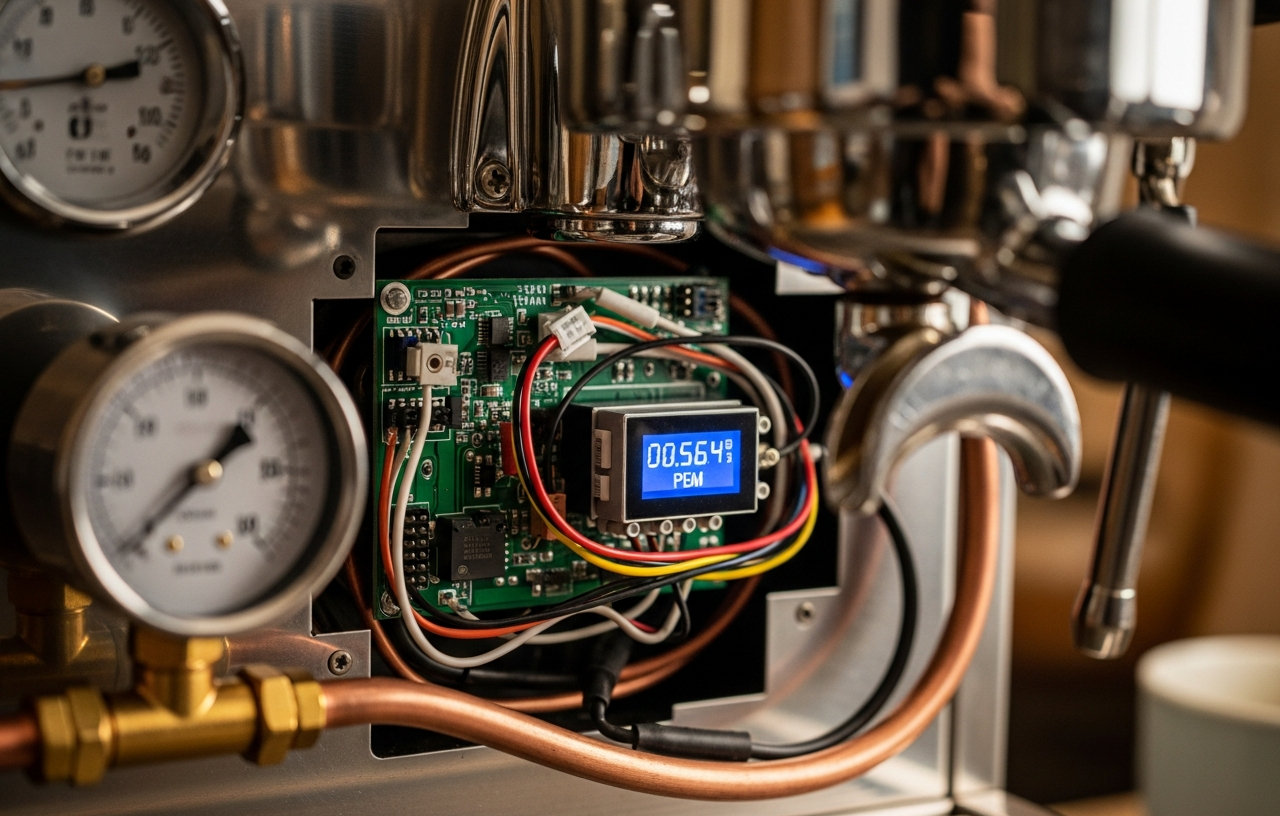
These three components work in concert. The PID controller takes readings from a temperature sensor (thermistor or RTD) placed in the boiler or brew path. It feeds this data into its algorithm, calculates the precise power needed for the heating element, and then sends a corresponding signal. This process happens many times per second, allowing for dynamic and highly responsive temperature management. For example, when cold water enters the boiler for brewing, the PID quickly detects the temperature drop and precisely modulates the heating element to bring it back to the set point without overshooting.
Why Temperature Stability is Critical for Espresso Quality
Even a small variation in brew water temperature can significantly impact the taste of espresso. Coffee contains hundreds of soluble compounds, and their solubility varies with temperature. The ideal temperature range for espresso extraction is generally considered to be between 195°F and 205°F (90°C and 96°C).
Brewing below this range, for example at 190°F, often results in under-extraction. This typically produces a sour, thin, and underdeveloped shot because not enough of the desirable compounds, such as sugars and acids, have dissolved. The shot may lack body and have a watery consistency.
Conversely, brewing above the ideal range, perhaps at 210°F, can lead to over-extraction. This extracts too many bitter and acrid compounds, resulting in a harsh, burnt, or rubbery taste. The shot may also feel dry on the palate. Achieving the perfect balance of flavors, body, and aroma requires highly stable and repeatable temperature control.
A PID controller directly addresses this challenge. It minimizes the temperature fluctuations that occur during the brewing process, especially as cooler water enters the system or as heat is lost to the group head. This consistency allows the barista to focus on other variables like grind size, dose, and tamp, knowing that the temperature foundation is solid.
PID vs. Thermostat: The Key Difference
The primary difference between a PID controller and a traditional thermostat lies in their method of temperature regulation and their resulting precision. Most entry-level espresso machines, particularly those under $400, use a simple thermostat.
Thermostat Control
A thermostat operates like an on/off switch. It has a single setpoint. When the water temperature drops below this setpoint, the thermostat turns the heating element on at full power. Once the temperature rises above a certain threshold (often several degrees higher than the setpoint), the thermostat turns the heating element off. This creates a wider temperature swing, known as hysteresis. For instance, a thermostat set to 200°F might allow the temperature to drop to 195°F before turning on and rise to 205°F before turning off. This 10-degree Fahrenheit swing is significant for espresso extraction.
PID Control
A PID controller, by contrast, does not simply switch the heating element on or off. Instead, it continuously modulates the power supplied to the heating element. It can apply 10%, 50%, or 90% power, or any intermediate value, based on its calculations. This proportional control allows the PID to 'feather' the heating element, keeping the temperature much closer to the setpoint with minimal overshoot or undershoot. The temperature stability achieved with a PID is typically within 0.5 to 1 degree Fahrenheit, providing superior consistency shot after shot.
This difference in control method directly translates to shot consistency. Machines with thermostats often require temperature surfing, where the barista manipulates the machine (e.g., flushing water) to try and hit the desired temperature window. A PID system largely eliminates this need, making the process more repeatable and less prone to user error.
Benefits of a PID Controller for Home Baristas
For home espresso enthusiasts, incorporating a PID controller into their setup offers several tangible advantages:
- Improved Shot Consistency: The most significant benefit is the ability to produce consistent shots every time. This means less wasted coffee and a more predictable outcome, allowing for easier dialing in of new beans.
- Enhanced Flavor Clarity: Stable temperature ensures optimal extraction of desirable compounds, leading to a cleaner, more nuanced, and balanced flavor profile in the cup. Bitterness and sourness are minimized.
- Greater Control and Experimentation: Many PID controllers allow the user to adjust the brew temperature to a specific degree. This enables experimentation with different roast levels and coffee origins, as some beans express their best qualities at slightly different temperatures. For example, a light roast might benefit from a slightly higher brew temperature than a dark roast.
- Reduced Temperature Surfing: With a PID, baristas do not need to perform temperature surfing, which saves time and simplifies the brewing process. The machine is ready to brew at the target temperature.
- Faster Warm-up: While not a direct function of PID, many machines with PID also feature more robust heating elements and insulation, contributing to faster overall machine warm-up times.
Common Misconceptions About PID Controllers
First, a PID controller is not a magic bullet that solves all espresso problems. It ensures temperature stability, but factors like grind size, coffee dose, tamping pressure, and bean freshness remain absolutely critical for a good shot. A perfectly stable temperature cannot compensate for a poor grind or an incorrect dose.
Second, not all PIDs are created equal. The effectiveness of a PID system depends on its tuning (the specific values of P, I, and D parameters), the quality and placement of the temperature sensor, and the overall design of the machine's heating system. Some manufacturers offer user-adjustable PID settings, while others are factory-set. A poorly tuned PID might still have some temperature oscillations, though usually much smaller than a thermostat.
Finally, a PID is not exclusively for advanced users. While it provides granular control that experienced baristas appreciate, even beginners benefit immensely from the increased consistency and reduced variables. It makes the learning curve for espresso less frustrating by removing one major source of variability.
When to Consider an Espresso Machine with a PID
If you are serious about improving your espresso quality and consistency at home, an espresso machine with a PID controller is a worthwhile investment. These machines typically start in the $500 to $700 range for single boiler models and can go upwards of $2000 for dual boiler or heat exchanger systems with advanced PID integration. Entry-level machines, like some models in the Breville Bambino series, offer excellent value with basic PID control, while higher-end machines from brands like Rancilio, ECM, and Profitec feature more sophisticated PID implementations.
Consider a PID-equipped machine if you:
- Consistently want to pull high quality, repeatable espresso shots.
- Are upgrading from a basic, thermoblock, or thermostat-controlled machine.
- Enjoy experimenting with different coffee beans, roast levels, and extraction temperatures.
- Value precision and consistency in your daily coffee ritual.
While machines without PID can certainly make good espresso, the addition of this technology significantly enhances control and reduces variability. For a deeper understanding of espresso machine costs, you can explore our guide on How Much Does a Good Espresso Machine Really Cost?
Beyond PID: Other Factors for Temperature Stability
While the PID controller is a central component for temperature stability, it operates within the broader context of the espresso machine's design. Other factors also contribute to maintaining a consistent brew temperature:
- Boiler Type and Size: Dual boiler machines, which have separate boilers for brewing and steaming, offer superior temperature stability because the brewing temperature is unaffected by the demands of steam. Heat exchanger (HX) machines use a single boiler but route brew water through a heat exchange tube, also providing good stability, especially when paired with a PID. Larger boilers generally have more thermal mass and are less prone to rapid temperature drops.
- Group Head Design: Heavy, thermally stable group heads, such as the E61 group or saturated group heads, act as a thermal buffer. They maintain their temperature well and minimize heat loss as water travels from the boiler to the coffee puck.
- Heating Element Power: A sufficiently powerful heating element allows the machine to recover temperature quickly after a shot or during steaming, which is especially important in single-boiler or HX designs.
- Insulation: Good insulation around the boiler helps to retain heat, reducing temperature fluctuations and improving energy efficiency.
A PID controller works in conjunction with these design elements. It provides the intelligent control, but the physical components of the machine provide the thermal foundation. A well designed espresso machine integrates a robust heating system with an accurate PID controller to deliver the best possible temperature stability for exceptional espresso.