Every espresso machine, regardless of its price point or complexity, relies on a core set of components to produce a shot. These parts, including the pump, boiler, and group head, are responsible for heating water, generating pressure, and delivering it to the coffee grounds at precise specifications. Understanding the function of each part is vital for home baristas seeking to improve their brewing skills and troubleshoot common issues.
The Water System: From Reservoir to Brew
The journey of water through an espresso machine begins in the reservoir and ends at the coffee puck. Each component in this path plays a critical role in delivering water at the correct temperature and pressure.
Water Reservoir or Tank
This is where the machine stores the water used for brewing and steaming. Most home espresso machines feature a removable plastic or glass reservoir, typically holding between 1 and 2.5 liters. The water quality here directly impacts the taste of your espresso and the longevity of the machine. Hard water, for instance, leads to scale buildup in the boiler and pipes, requiring regular descaling.
The Pump: Generating Pressure
The pump is the engine of an espresso machine, responsible for pushing water through the finely ground coffee at high pressure. There are two primary types of pumps found in home machines:
- Vibratory Pumps: These are common in entry-level and mid-range machines, often costing between $200 and $1,500. They use an electromagnet to vibrate a piston, generating pressure. Vibratory pumps are generally louder and have a shorter lifespan than rotary pumps. They produce pressure in pulses, typically reaching 12-15 bars, which is then regulated down to the ideal 9 bars at the group head.
- Rotary Pumps: Found in higher-end prosumer and commercial machines, typically above $1,500. These pumps use a motor to spin a rotor, creating consistent, quieter pressure. Rotary pumps are more durable and can draw water directly from a plumbed-in water line, offering consistent pressure delivery.
Regardless of the pump type, the goal is to achieve approximately 9 bars of pressure at the coffee puck. Water too cold results in sour, underdeveloped shots, while water too hot can lead to bitter, over-extracted coffee. Espresso machines use either a boiler or a thermoblock system:
- Boilers: These are typically made of brass, copper, or stainless steel. They heat a fixed volume of water. Single-boiler machines, common in the $300-$800 range, use one boiler for both brewing (around 90-96°C) and steaming (over 120°C), requiring a temperature change between tasks. Heat exchange (HX) boilers have a single large boiler that maintains steam temperature, with a heat exchange tube running through it to flash-heat brew water on demand. Dual boiler machines, often found above $1,200, feature separate boilers for brewing and steaming, allowing simultaneous and precise temperature control for both functions.
- Thermoblocks: These are instant-heating aluminum blocks with a coiled water path. They heat water quickly as it passes through, making them common in compact and super-automatic machines. While fast, they may offer less temperature stability than boilers, though modern designs have improved significantly.
Group Head: The Final Delivery Point
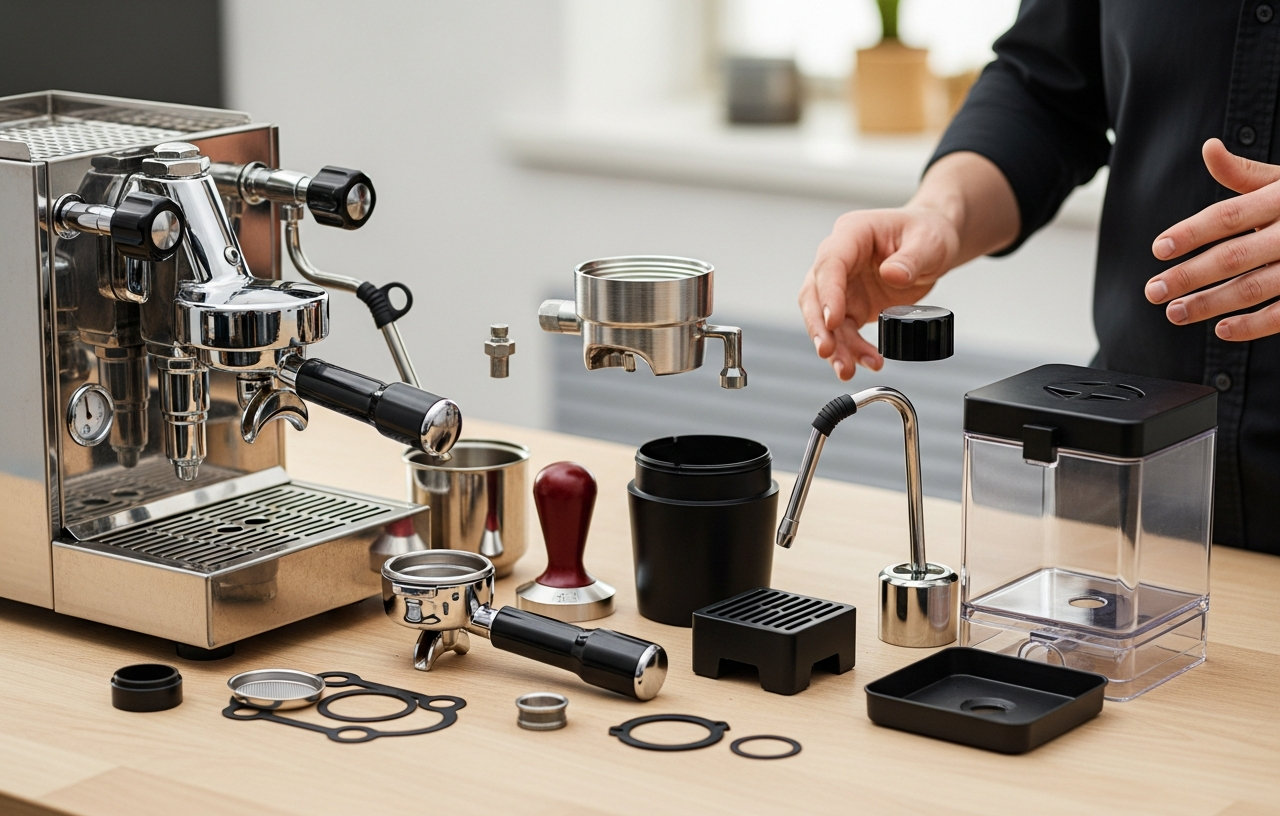
The group head is the part of the machine where the portafilter locks in, and hot water is delivered to the coffee grounds. It is a critical component for temperature stability and even water dispersion.
- Standard Group Heads: Most home machines use a basic group head design where water exits directly from the boiler or thermoblock.
- What is an E61 Group Head? The E61 group head is an iconic design originating from Faema in 1961. It is a large, heavy, chrome-plated brass component known for its exceptional thermal stability. Water continuously circulates through the E61 group head from the boiler, keeping it at a consistent temperature. This design also facilitates mechanical pre-infusion, gently saturating the coffee puck before full pressure is applied, which can lead to a more even extraction. E61 group heads are a hallmark of many prosumer espresso machines, typically costing upwards of $1,000.
Solenoid Valve
A 3-way solenoid valve is present in many espresso machines. Its purpose is to relieve pressure from the portafilter after brewing. When the brew cycle ends, it reroutes residual water and pressure from the group head into the drip tray. This action prevents the portafilter from spraying coffee grounds when removed and results in a drier, more easily discarded coffee puck. Machines without a 3-way solenoid valve may have a wet, muddy puck after brewing.
The Brewing System: Holding and Extracting Coffee
These components are directly involved in holding the coffee grounds and facilitating the extraction process.
Portafilter
The portafilter is the handle with a basket where ground coffee is placed. It locks into the group head. Portafilters come in various sizes, with 58mm being the industry standard for commercial and many prosumer machines. However, many popular home machines, such as several Breville models, use a what size is Breville portafilter of 54mm. Make sure your portafilter matches your machine's group head size.
- Non-Pressurized Portafilter: These portafilters have a single, unfiltered hole at the bottom of the basket. They require a precise grind size, consistent tamping, and fresh coffee to build the necessary resistance for proper espresso extraction. This type is preferred by experienced baristas for maximum control over the shot.
- What is a Pressurized Portafilter? Also known as a dual-wall or crema-enhancing portafilter, this design has a small, restricted opening at the bottom of the basket. This restriction creates artificial back pressure, helping to generate crema even with less-than-ideal grind consistency or stale coffee. Pressurized portafilters are common in entry-level machines, offering a more forgiving brewing experience for beginners.
For more details on preparing your coffee, see our article on What is the Purpose of a Coffee Tamper?
Shower Screen and Gasket
The shower screen is a perforated metal disc located inside the group head, above where the portafilter locks in. Its function is to disperse water evenly over the coffee puck, promoting a uniform extraction. A dirty or clogged shower screen can lead to channeling and uneven shots. The group head gasket, typically made of rubber, creates a seal between the portafilter and the group head, preventing leaks during brewing. Gaskets wear out over time and need periodic replacement.
Drip Tray
The drip tray collects excess water, spent coffee, and any spills from the brew process or steam wand. Most drip trays include a grid to keep cups elevated and a float indicator to signal when it needs emptying. Regular cleaning of the drip tray is important to prevent mold and odors.
The Steam System: Frothing Milk for Lattes
For milk-based drinks, the steam system is just as important as the brewing system.
Steam Wand
The steam wand is a metal tube that extends from the machine, used to froth milk. It delivers high-pressure steam, generated by the boiler, into milk to create microfoam. Steam wands can have different tip designs (e.g., one hole, two holes, four holes), which affect the speed and power of steaming. A single-hole tip provides a slower, more controlled steam flow, often preferred by beginners, while multi-hole tips offer more power for faster frothing, common in commercial settings.
Steam Valve
The steam valve controls the release of steam through the steam wand. It can be a knob or a lever. Opening the valve allows steam to escape, while closing it stops the flow. Proper operation of the steam valve is essential for controlling the texture and temperature of frothed milk.
Control and Safety Components
Modern espresso machines incorporate various controls and safety features to make operation easier and prevent damage.
PID Controller
A Proportional-Integral-Derivative (PID) controller is an advanced electronic thermostat found in many mid-to-high end espresso machines. It precisely monitors and maintains the boiler's temperature, reducing temperature fluctuations and leading to more consistent espresso shots. Machines with PID controllers offer digital temperature displays and often allow users to adjust the brew temperature in 1-degree increments, providing greater control over extraction.
Pressure Gauge
Many machines include a pressure gauge, which displays the pressure generated by the pump during brewing. Observing the needle during extraction can provide feedback on your grind size and tamping technique. A gauge reading significantly above or below 9 bars during an active shot indicates a problem with the coffee preparation.
Temperature Sensor
These sensors, typically thermistors or thermocouples, monitor the temperature of the boiler or thermoblock. They send data to the machine's control board or PID, which then adjusts the heating element to maintain the desired temperature set point.
Over-Pressure Valve (OPV)
The Over-Pressure Valve is a safety and performance component. It regulates the maximum pressure applied to the coffee puck. While a pump might generate 12-15 bars of pressure, the OPV is typically set to release excess pressure, ensuring only 9-10 bars reach the coffee. This prevents over-extraction and protects the machine's internal components from excessive force.
Flowmeter
Found in volumetric machines, a flowmeter measures the volume of water dispensed during a brew cycle. This allows for programmable shot volumes, where the machine stops the brew automatically once a set amount of water has passed through the coffee, ensuring consistent shot sizes.
External Components and User Interface
These are the parts you interact with directly.
Housing and Chassis
The external housing encases all the internal components, providing structural support and protection. Materials range from plastic in entry-level models to polished stainless steel or chrome in premium machines. The chassis, often made of steel, forms the internal frame that holds everything together.
Control Panel and Buttons/Levers
This is the user interface of the machine. It includes buttons for power, brewing, steaming, and sometimes programmable shot volumes. Higher-end machines may feature levers for manual control over brew cycles, common with E61 group heads, allowing for nuanced pre-infusion techniques.
Understanding Your Machine's Inner Workings
Familiarity with the parts of an espresso machine, from the water reservoir to the steam wand, empowers you to diagnose problems, perform routine maintenance, and ultimately pull better shots. Each component, no matter how small, contributes to the complex process of transforming ground coffee into a delicious espresso. Regular cleaning of components like the portafilter, shower screen, and steam wand is essential to maintain optimal performance and taste quality.