The Fundamental Difference: How Burrs Grind Coffee
Coffee grinders are the most critical component for achieving excellent coffee, and their performance hinges on the burr type: either flat or conical. These two designs dictate grind particle consistency, heat generation, and overall user experience. The core function of both burr types is to crush and shear roasted coffee beans into small, uniform particles suitable for brewing.
Understanding the mechanical action of each burr shape clarifies their respective advantages and disadvantages. This distinction is not merely academic. It translates directly into the taste profile of your brewed coffee, whether it is a bright espresso shot or a rich French press.
Flat Burrs: Precision and Uniformity for Espresso
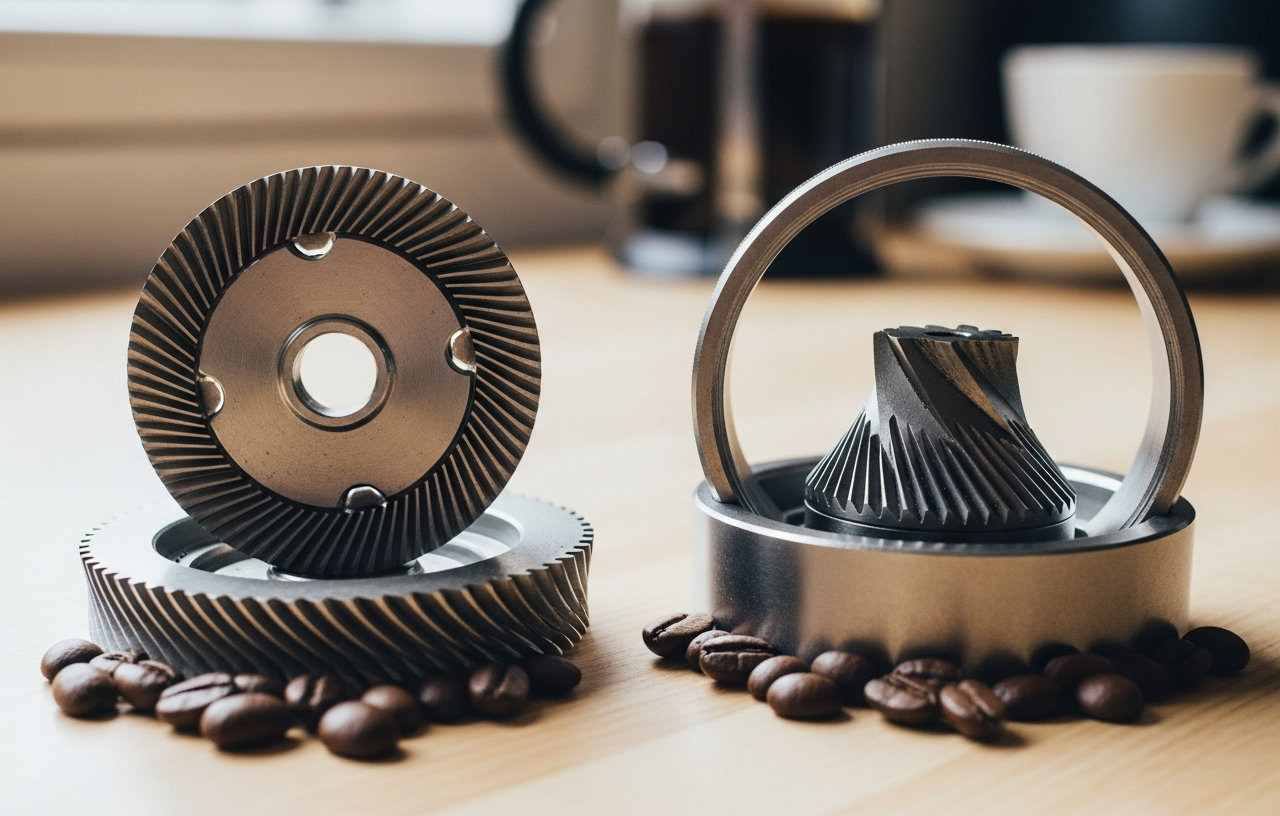
Flat burrs consist of two parallel, ring-shaped grinding surfaces. One burr remains stationary, while the other rotates at high speed. Coffee beans feed into the center of these burrs. Centrifugal force pushes the beans outwards, between the grinding surfaces, until they are ground to the desired fineness. The grinding action occurs in a single pass as the coffee travels from the center to the edge.
Grind Consistency and Particle Distribution
Flat burrs are renowned for their ability to produce an exceptionally uniform grind. Many high end flat burr grinders produce a 'bimodal' particle distribution. This means the grind contains two distinct peaks of particle sizes: a very fine group and a slightly coarser group. This bimodal distribution can contribute to a complex espresso shot, offering both clarity and body in the cup.
For example, a particle analysis might show a significant cluster of particles around 200 microns for fines and another cluster around 500 microns for coarser particles. This precise engineering is a hallmark of quality flat burr systems.
Heat Generation and Noise Levels
The design of flat burrs means coffee particles spend a longer time in contact with the grinding surfaces compared to conical burrs. This extended contact, combined with the higher rotational speeds often employed, can generate more heat. Excessive heat can degrade delicate coffee aromatics, leading to a less vibrant flavor profile. While modern flat burr grinders often incorporate cooling fins or slower motors to mitigate this, it remains a characteristic to consider.
Flat burr grinders also tend to be louder during operation. The high-speed rotation and the nature of the grinding action produce a distinct, often higher-pitched, noise. This can be a factor for home baristas in shared living spaces or those sensitive to noise.
Grind Retention and Cleaning
Due to their design, flat burr grinders can have higher grind retention. This means a small amount of ground coffee remains lodged within the burr chamber and chute after each use. For home users, this old coffee can oxidize and affect the flavor of subsequent brews. Regular cleaning is important to minimize this issue. Some flat burr grinders include features like blow-up hoppers or specific chute designs to help reduce retention.
Conical Burrs: Efficiency and Versatility
Conical burrs consist of an inner cone-shaped burr that rotates inside a stationary, ring-shaped outer burr. Coffee beans are fed into the top of this assembly and are crushed and sheared as they fall downwards, through the progressively narrower gap between the burrs. The grinding action occurs in multiple stages, with gravity assisting the movement of the beans.
Grind Consistency and Particle Distribution
Conical burrs produce a very good, consistent grind, suitable for a wide range of brewing methods. While sometimes considered slightly less uniform than high end flat burrs, they excel at maintaining consistency across various grind settings, from coarse for French press to fine for espresso. Many conical burr grinders produce a 'unimodal' particle distribution, meaning a single, tighter cluster of particle sizes. This can result in a cleaner, brighter cup with less sediment, especially noticeable in pour-over or drip coffee.
For espresso, conical burrs often create a more forgiving shot, as their particle distribution can be less prone to channeling. This makes them a popular choice for beginners and those who value ease of use.
Heat Generation and Noise Levels
One significant advantage of conical burrs is their lower heat generation. Coffee particles pass through the burrs quickly and are ground with less friction, minimizing heat transfer to the coffee. This helps preserve the delicate aromatics and flavors of the beans.
Conical burr grinders are also typically quieter than flat burr models. The slower rotational speeds and the crushing action often result in a lower-pitched, less intrusive sound profile. This can be a major benefit for early morning coffee routines.
Grind Retention and Cleaning
Conical burr grinders generally have lower grind retention. The vertical, gravity-fed design allows most of the ground coffee to fall directly into the catch bin, leaving minimal residue in the grinding chamber. This reduces wasted coffee and helps maintain freshness between uses. Cleaning is still important, but the impact of retained coffee is often less pronounced than with flat burrs.
Key Differences in Grind Profile and Extraction
The distinct particle distributions created by flat and conical burrs lead to different extraction characteristics and flavor profiles in the brewed coffee. A bimodal distribution from flat burrs, for example, might allow for a more complex espresso shot where the finer particles contribute to body and crema, while the coarser particles allow for a balanced extraction of flavors.
A unimodal distribution from conical burrs, conversely, can lead to a cleaner, brighter, and more transparent cup, especially in methods like pour-over, where clarity is often desired. The uniform particle size helps prevent over-extraction of fines and under-extraction of coarser particles, resulting in a balanced flavor with less bitterness or astringency.
For espresso, the choice often comes down to preference: flat burrs for extreme clarity and distinct flavor separation, or conical burrs for a more rounded, full-bodied, and forgiving shot. Both can produce excellent results, but their strengths lie in different aspects of the extraction.
Factors Beyond Burr Shape: Material, Size, and Motor
While the shape of the burrs is a primary differentiator, other characteristics significantly impact a grinder's performance. These include the material the burrs are made from, their size, and the type of motor driving them.
Burr Material and Size
Most burrs are made from either hardened steel or ceramic. Steel burrs are common in both flat and conical designs. They are durable and can be machined to very precise tolerances, producing sharp cutting edges. Ceramic burrs are harder and can have a longer lifespan, especially in manual grinders, but they are more brittle and can chip if a foreign object like a stone enters the grinding chamber. Steel burrs are generally preferred for espresso applications due to their precision.
Burr size, measured in millimeters, is also important. Larger burrs generally mean more grinding surface area and can process coffee faster and more efficiently, often with less heat generation. A typical entry-level grinder might have 38-40mm burrs, while high end commercial grinders can feature 75mm or even 83mm burrs. A 64mm flat burr grinder, for instance, will perform differently than a 38mm conical burr grinder, even if both are otherwise well built.
Motor Speed and Grind Adjustment
The motor drives the burrs. Some grinders use direct drive motors, while others use gear reduction systems to slow down the burr speed. Slower burr speeds generally reduce heat and noise, which is beneficial for preserving coffee flavor. However, slower speeds can also mean slower grinding. The balance between speed, heat, and noise is a key design consideration for manufacturers.
The grind adjustment mechanism is another critical factor. Stepped adjustments offer discrete settings, which are easy to replicate. Stepless adjustments provide infinite control, allowing for extremely fine-tuning, which is often preferred for espresso where small changes can significantly impact extraction. For example, a grinder with micro-adjustments for espresso allows for dialing in shots with greater precision than one with only coarse steps.
Maintenance and Longevity of Coffee Grinder Burrs
Regardless of burr type, proper maintenance extends the life of your grinder and ensures consistent grind quality. Coffee beans contain oils that can build up on the burrs and in the grinding chamber, eventually becoming rancid and affecting coffee flavor. Regular cleaning removes these oil residues and any old coffee particles.
Cleaning frequency depends on usage, but a general guideline is to clean every 1-2 weeks for daily users. This often involves running a grinder cleaning tablet or a small amount of uncooked rice (use sparingly and with caution, as it can be hard on some motors) through the grinder, followed by brushing out the burrs. For a deeper clean, periodic disassembly of the burr set is recommended. Make sure to consult your grinder's manual for specific cleaning instructions.
Burr replacement is also part of a grinder's lifecycle. Steel burrs typically last for hundreds of pounds of coffee before they become dull and need replacement. Ceramic burrs generally have a longer lifespan. The exact lifespan varies based on roast level (darker roasts are oilier and can wear burrs faster) and frequency of use. Dull burrs will produce an inconsistent grind, increase grinding time, and generate more heat, all of which negatively impact coffee quality.
For more detailed cleaning advice, you can refer to our article: Quick Coffee Grinder Cleaning: No Disassembly Required
Choosing the Right Burr Type for Your Brewing Method
The best burr type for you depends largely on your primary brewing method and personal preferences.
- Espresso: Both flat and conical burrs can produce excellent espresso. Flat burrs are often favored by enthusiasts seeking maximum clarity and distinct flavor separation. Conical burrs, especially at entry to mid-range price points, can be more forgiving and offer a good balance of body and flavor. For a beginner buying their first grinder for espresso, a conical burr grinder often provides a great starting point due to its versatility and ease of use.
- Drip/Pour Over: Both burr types perform well for these methods. Conical burrs are often a popular choice due to their consistent grind across medium settings and lower heat generation, which preserves aromatics for a cleaner cup.
- French Press: This method requires a very coarse and consistent grind to avoid excessive sediment. Conical burrs often excel here, providing a uniform coarse grind with less fines than some flat burr designs.
Consider your daily coffee routine. If you switch between brewing methods frequently, a versatile conical burr grinder might be more suitable. If you are solely focused on dialing in the perfect espresso shot, a dedicated flat burr grinder could be the ideal choice.
To understand more about the fundamental difference between grinding mechanisms, read our comparison: Burr Grinder vs Blade Grinder: Which One Makes Better Coffee?
Cost Considerations for Flat vs. Conical Burr Grinders
The price range for coffee grinders with flat or conical burrs is vast, extending from under $100 to several thousand dollars for high end commercial-grade units. Generally, entry-level conical burr grinders are more accessible.
An entry-level conical burr grinder suitable for various brew methods can cost between $180 and $250. These models provide a significant upgrade over blade grinders and offer good consistency for home use. For example, popular home conical grinders like the Baratza Encore fall into this range.
Entry-level flat burr grinders, particularly those designed for espresso, typically start around $400-500. This is because achieving the precision required for flat burrs to outperform conical designs often necessitates higher quality materials, more powerful motors, and more robust construction. Mid-range flat burr espresso grinders often sit in the $600-1,000 range. high end flat and conical burr grinders, often used in professional settings, can easily exceed $1,500.
The cost is not solely tied to the burr shape. It also reflects the motor quality, build materials, grind adjustment mechanism, and overall durability. A well built grinder, whether flat or conical, represents a long term investment in coffee quality.