The core difference between burr and blade coffee grinders lies in their fundamental mechanism: burr grinders mill coffee beans by crushing them between two abrasive surfaces, while blade grinders chop beans with rapidly spinning blades. This distinction directly affects grind consistency, which is the single most critical factor for optimal coffee extraction and flavor.
The Fundamental Mechanisms: Crushing vs. Chopping
Understanding how each grinder operates clarifies why one is generally preferred for quality coffee. The method of particle size reduction dictates the uniformity of the coffee grounds, which in turn dictates how evenly water can extract soluble compounds during brewing.
Burr Grinders: Precision Milling
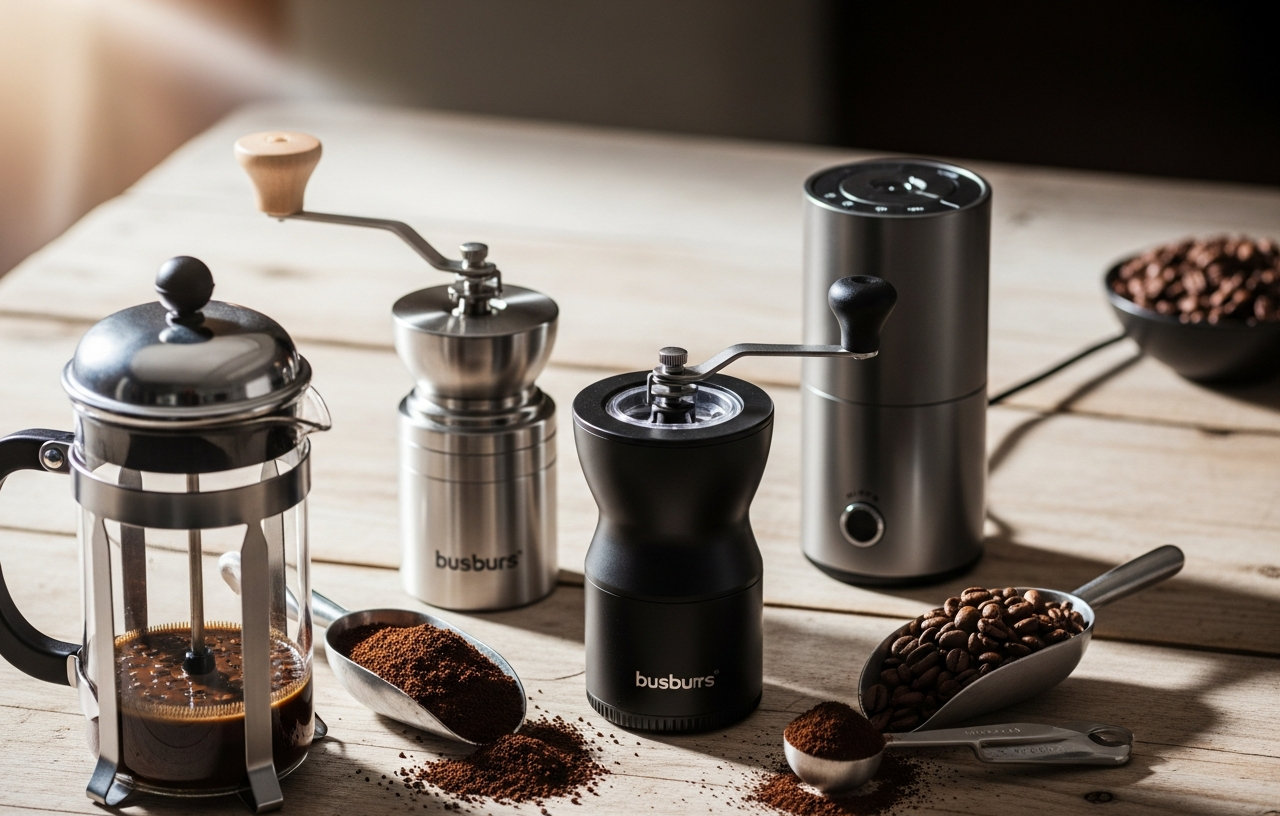
A burr grinder uses two revolving abrasive surfaces, or burrs, to grind coffee beans. Beans feed into the gap between these burrs, which are typically made of steel or ceramic. One burr remains stationary while the other rotates, drawing the beans through and crushing them into consistently sized particles. The gap between the burrs determines the fineness or coarseness of the grind. Adjusting this gap allows for precise control over particle size, from a very fine powder suitable for espresso to a coarse grind for French press.
- Conical Burrs: These feature two cone-shaped burrs, one fitting inside the other. They operate at lower RPMs (revolutions per minute), typically 400-600 RPM for electric models, which helps reduce heat generation. Conical burrs are known for high torque and excellent grind consistency, often found in both manual and electric grinders.
- Flat Burrs: Flat burrs consist of two parallel, ring-shaped burrs with teeth. Beans enter the center and are centrifugally forced outwards, passing through the teeth to be ground. Flat burrs often operate at higher RPMs, sometimes exceeding 1000 RPM, which can generate more heat. However, modern designs manage this well, and they are capable of producing very consistent grinds, particularly for espresso.
The crushing action makes sure that each coffee particle has a similar surface area. This uniformity is vital because it allows water to extract flavor compounds at a similar rate from all grounds, leading to a balanced and predictable cup of coffee.
Blade Grinders: Inconsistent Chopping
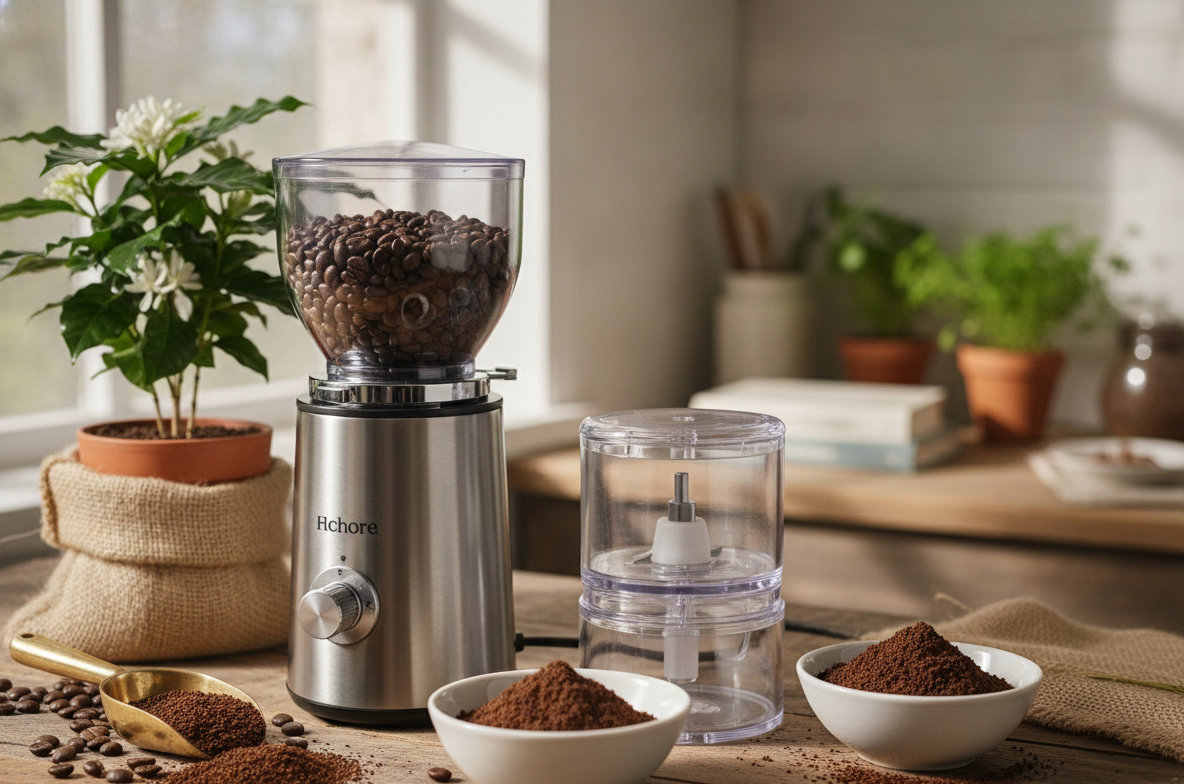
Blade grinders, often marketed as "spice grinders" or "coffee mills," operate more like blenders. They use a rapidly spinning propeller-like blade, typically rotating at 20,000-30,000 RPM, to chop and shatter coffee beans. There are no adjustable burrs to set particle size. Instead, the fineness of the grind depends on how long the blades run. Longer grinding times produce finer particles, but at the cost of consistency.
The chopping action of a blade grinder results in a highly inconsistent particle size distribution. You will find a mix of very fine dust (fines) alongside larger, coarser chunks (boulders). This unevenness is detrimental to coffee quality because different sized particles extract at different rates. Fines will over-extract quickly, leading to bitterness and astringency, while boulders will under-extract, resulting in sourness and a weak flavor.
Grind Consistency and Flavor Extraction
Grind consistency is not merely a preference. It is a scientific requirement for optimal coffee brewing. The surface area of coffee grounds directly influences extraction speed. A consistent grind means all particles offer a similar surface area to the brewing water, allowing for even and complete extraction of soluble solids.
A high quality burr grinder, even an entry-level electric model in the $70-$150 range like a Baratza Encore, can produce grounds where 80-90% of particles fall within a narrow target micron range for a given setting. For example, a medium grind for pour over might target particles between 600-800 microns. This uniformity prevents both over-extraction and under-extraction in the same brew.
Conversely, a blade grinder creates a wide spectrum of particle sizes. A typical blade grinder output for a "medium" grind will contain particles ranging from less than 100 microns (dust) to over 1500 microns (large chunks). When hot water hits this mixed bed of grounds, the fine particles release their flavors almost instantly, often becoming bitter. The large chunks, meanwhile, release very little flavor, leaving the coffee weak and underdeveloped. The resulting cup often tastes muddled, simultaneously bitter and sour, lacking clarity and sweetness.
Heat Generation and Bean Integrity
The grinding process itself generates heat. Excessive heat can degrade the delicate aromatic compounds in coffee beans, leading to a duller, less vibrant flavor. This is a significant factor when comparing burr and blade grinders.
Burr grinders, particularly those with conical burrs operating at lower RPMs, generate less heat. The crushing action is more controlled, and the beans pass through the grinding mechanism relatively quickly. While some heat is always produced, it is usually minimal enough not to significantly impact the flavor profile of the coffee, especially in home-use grinders.
Blade grinders, with their extremely high RPMs and violent chopping action, generate considerably more friction and heat. The blades can "burn" the coffee, especially if operated for extended periods to achieve a finer grind. This heat accelerates the oxidation of coffee oils and volatilizes delicate aromatics, resulting in a noticeably flatter, sometimes stale, taste. The unpleasant smell of hot, burnt coffee grounds is a clear indicator of this issue.
Noise Levels and Operational Speed
The difference in grinding mechanisms also translates to variations in noise levels and operational speed.
Blade grinders are generally very loud due to the high-speed motor and the violent impact of the blades shattering the beans. The noise can be abrupt and jarring, often reaching decibel levels comparable to a blender (around 85-95 dB). The grinding process for a single dose of coffee is usually quick, taking 10-20 seconds.
Electric burr grinders vary in noise. Entry-level models might be somewhat loud, but generally less jarring than blade grinders, often in the 70-80 dB range. Higher-end burr grinders, especially those with larger burr sets and slower motors, can be significantly quieter. Manual burr grinders are the quietest option, producing minimal noise from the hand-cranking action and the gentle crushing of beans.
The speed of grinding also differs. Blade grinders are quick because they process beans by impact. Burr grinders, by design, are slower as they meticulously crush beans to a specific size. This slower process is a trade-off for superior grind quality.
Cost and Maintenance Considerations
The initial cost and ongoing maintenance requirements differ substantially between the two grinder types, reflecting their design complexity and performance capabilities.
Initial Investment
Blade grinders are the most inexpensive option, typically costing between $20 and $50. Their simple motor and blade design keep manufacturing costs low. They are widely available in supermarkets and general merchandise stores.
Burr grinders represent a wider price spectrum. Manual burr grinders can range from $30 to $100, offering excellent grind quality for their price point, though they require manual effort. Electric burr grinders for home use start around $70 for basic models and can extend to $300-$500 for enthusiast-grade machines with advanced features like digital timers and anti-static properties. Commercial-grade burr grinders can exceed $1000.
Cleaning and Durability
Cleaning a blade grinder involves wiping out the chamber, which can be messy due to static cling and the accumulation of fine dust. The blades themselves can become dull over time, though replacement is often not cost effective for these inexpensive appliances. The motors are generally not designed for heavy, continuous use, and their lifespan can be limited, especially if used for grinding oily espresso beans daily.
Burr grinders require more specific cleaning to maintain optimal performance. Regular cleaning involves disassembling the burrs (often just the top burr) and brushing away accumulated coffee oils and grounds. Manufacturers recommend this process every few weeks for daily users. Burrs, especially ceramic ones, can last for many years of home use, typically grinding hundreds of pounds of coffee before needing replacement. Steel burrs may last longer but can dull if exposed to foreign objects like small stones sometimes found in coffee beans. Quick Coffee Grinder Cleaning: No Disassembly Required
Brew Method Suitability
The choice between a burr and blade grinder significantly impacts the quality of coffee for different brewing methods.
Espresso
Espresso requires an extremely fine and, critically, a highly consistent grind. Particle size directly influences the flow rate of water through the coffee puck and thus the extraction. A variation of even 50-100 microns in particle size can drastically alter extraction time and flavor balance. Only a burr grinder can achieve the necessary uniformity and fineness for espresso. Blade grinders are entirely unsuitable for espresso, as their inconsistent grind will lead to channeling (water finding paths of least resistance) and a poor, uneven extraction.
Pour Over and Drip Coffee
These methods require a medium grind, consistent enough to allow for even saturation and extraction over a 2-5 minute brew time. A burr grinder provides the control needed to select the correct medium setting and makes sure of uniform extraction. While a blade grinder can produce something resembling a medium grind, its inconsistency will result in a muddy brew, often tasting bitter from over-extracted fines and watery from under-extracted boulders.
French Press and Cold Brew
French press and cold brew require a coarse, very uniform grind. Large, evenly sized particles prevent excessive sediment in the cup and allow for a slow, gentle extraction without bitterness. Blade grinders are particularly poor for these methods because their chopping action creates a large amount of fine dust. This dust easily passes through the French press filter, resulting in a gritty, muddy cup. For cold brew, these fines can lead to over-extraction and bitterness even at cold temperatures. A burr grinder is essential for achieving the clean, coarse grind needed for these immersion methods.
For more information on grinders suitable for these methods, consider reading about Top Coffee Grinders for French Press Under $100.
Burr grinders use a precise crushing action to produce uniform particles, which is critical for consistent extraction and superior flavor. Blade grinders, by contrast, chop beans inconsistently, leading to uneven extraction, burnt flavors, and a generally inferior cup. For any home coffee enthusiast serious about brewing, a burr grinder is a foundational piece of equipment.