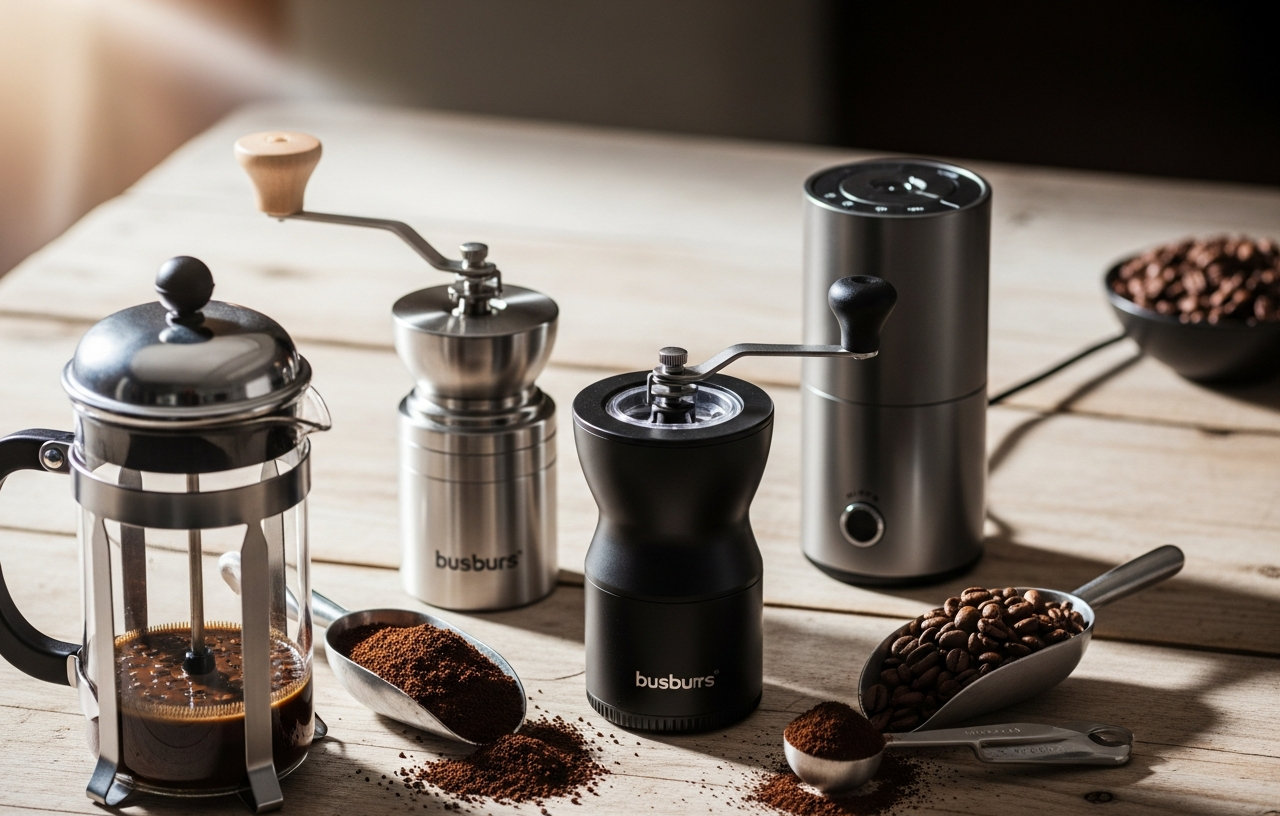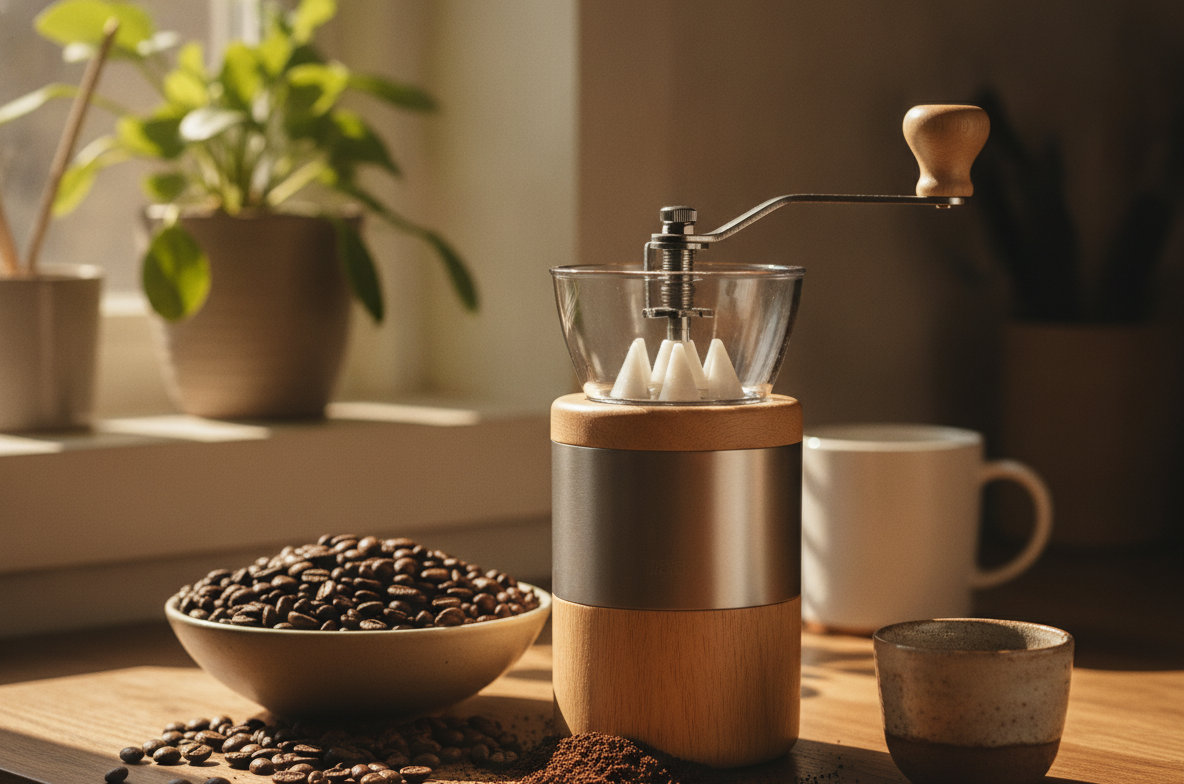
A ceramic burr grinder employs grinding components crafted from advanced ceramic compounds, most commonly zirconium dioxide. This material is distinguished by its exceptional hardness, measuring around 8.0 to 8.5 on the Mohs scale, significantly harder than standard steel. This inherent hardness allows ceramic burrs to retain their sharp edges for an extended period, contributing to consistent grind quality over the grinder's lifespan.
How Ceramic Burr Grinders Work
Ceramic burr grinders operate on the same fundamental principle as all burr grinders: they crush coffee beans between two abrasive surfaces, rather than chopping them like blade grinders. The burr set typically consists of two parts: a stationary burr and a rotating burr. As whole coffee beans are fed into the grinding chamber, the rotating burr draws them in, progressively crushing them against the stationary burr. The distance between these two burrs determines the fineness of the grind. Adjusting this distance allows users to select grinds suitable for various brewing methods, from coarse French press to fine espresso.
Conical burrs feature two cone-shaped components, one nested inside the other. This design is highly efficient at reducing beans to a uniform size with minimal effort. The beans pass through a progressively narrower channel, undergoing multiple crushing and shearing actions. This multi-stage grinding process is a key factor in the superior consistency achieved by burr grinders compared to blade grinders. The precision manufacturing of ceramic burrs ensures the grinding surfaces mate closely, allowing for precise control over particle size distribution.
The ceramic material itself plays a significant role in the grinding process. Its low thermal conductivity means that less heat transfers from the burrs to the coffee grounds during grinding. Excessive heat can prematurely degrade delicate aromatic compounds in coffee, leading to a dull or bitter taste. By minimizing heat generation, ceramic burrs help preserve the coffee's nuanced flavors and aromas, delivering a fresher tasting cup. This is particularly beneficial for longer grinding sessions or for users who prioritize flavor integrity above all else.
Advantages of Ceramic Burrs
Exceptional Durability and Longevity
Ceramic burrs are renowned for their impressive durability and resistance to wear. The material's high hardness means the grinding edges remain sharp for a much longer time than typical steel burrs, often lasting for many years, even with daily use. This translates to consistent grind quality throughout the grinder's operational life, without the gradual degradation in performance seen as softer burrs dull. For example, a well maintained ceramic burr grinder can offer consistent performance for over five to ten years, based on typical home use, before any noticeable decline in grind quality.
Reduced Heat Generation
One of the most significant advantages of ceramic burrs is their low thermal conductivity. As coffee beans are ground, friction naturally generates heat. Steel burrs, being good conductors, transfer this heat readily to the coffee grounds. Ceramic, however, insulates against heat transfer. Cooler grounds prevent premature oxidation and degradation of these compounds, resulting in a more flavorful and aromatic brew. This benefit is particularly noticeable when grinding larger quantities of coffee or for espresso, where fine grinds and longer grinding times can increase heat.
Consistent Grind Quality
The hardness and sharp edges of ceramic burrs contribute to a highly consistent grind. Particle size uniformity is critical for optimal coffee extraction. Uneven grinds lead to uneven extraction, where some particles are over-extracted (bitter) and others under-extracted (sour). Ceramic burrs produce a more uniform particle size distribution, reducing fines and boulders. This consistency is beneficial across all brewing methods, from pour over to French press, allowing for a more balanced and predictable extraction.
Quieter Operation
While not universally true for all models, ceramic burr grinders often operate with less noise compared to their steel counterparts. The inherent properties of ceramic, combined with specific grinder designs, can result in a quieter grinding experience. This can be a considerable advantage for home baristas who start their brewing routine early in the morning or live in shared spaces where noise reduction is appreciated. The sound profile is typically a lower, less metallic hum than the higher-pitched whir of some steel grinders.
Corrosion Resistance
Ceramic material is completely resistant to rust and corrosion, unlike steel. This makes cleaning and maintenance simpler and eliminates any concern about metallic taste transfer to the coffee grounds over time. This resistance also means the burrs will not degrade due to moisture, which can be a factor in humid environments or if coffee beans are not stored perfectly dry.
For a deeper understanding of grinder types, consider reading about the fundamental differences between burr and blade grinders. Burr Grinder vs Blade Grinder: Which One Makes Better Coffee?
Disadvantages of Ceramic Burrs
Brittleness and Fragility
Despite their hardness, ceramic burrs are inherently more brittle than steel burrs. This means they are susceptible to chipping or breaking if subjected to impact or if a hard foreign object, such as a small stone or an unroasted bean fragment, enters the grinding chamber. While rare, such an event can render the burr set unusable and require replacement. Steel burrs, by contrast, might bend or dull under similar stress but are less likely to shatter. Users must exercise caution to only grind clean, sorted coffee beans.
Potential for Slower Grinding Speed
Some ceramic burr grinders, particularly those in the manual grinder category or entry-level electric models, can have a slower grinding speed compared to high-performance steel burr grinders. This is sometimes due to the design optimizing for quiet operation or heat reduction rather than raw speed. For users grinding large batches of coffee regularly, this slower speed might become a minor inconvenience. However, for most home users making one or two cups, the difference is often negligible.
Limited Ultra-Fine Grind Capability in Some Models
While ceramic burrs excel at producing consistent grinds for most brewing methods, some models may not achieve the extremely fine and uniform particle size required for high end espresso machines. Espresso demands an incredibly precise grind, often below 300 microns, with very tight particle distribution. While many ceramic burr grinders can produce a fine grind, achieving the specific consistency and fineness for perfect espresso extraction, especially with unpressurized baskets, can sometimes be challenging for certain ceramic models. Premium steel burrs often have an edge in this very specific, high-demand application.
Initial Cost Considerations
Entry-level ceramic burr grinders can range from $30 to $80 for manual models, while electric versions typically start around $100 to $200. This is generally more expensive than basic blade grinders, which can be found for under $30. While ceramic burrs offer long term value due to their durability, the initial investment can be higher. This cost difference reflects the precision engineering and material expense associated with quality burr grinders. However, higher-end steel burr grinders can significantly exceed these price points, reaching several hundred dollars.
Ceramic vs. Steel Burrs: A Detailed Comparison
The choice between ceramic and steel burrs is a frequent point of discussion among coffee enthusiasts. Both materials offer distinct advantages and disadvantages that influence grind quality, durability, and overall user experience.
Material Properties and Hardness
Ceramic burrs, primarily zirconium dioxide, boast a hardness of 8.0 to 8.5 on the Mohs scale. This extreme hardness contributes to their exceptional wear resistance. They maintain sharp cutting edges for extended periods, ensuring consistent grind quality over many years. Steel burrs, typically made from hardened tool steel, range from 5.5 to 6.5 on the Mohs scale. While still very hard, steel burrs can dull more quickly than ceramic ones, especially with frequent use or if grinding very light roast beans which are harder. However, steel offers superior toughness and ductility, meaning it is less prone to catastrophic breakage from impact.
Heat Generation and Flavor Preservation
Ceramic's low thermal conductivity is a significant advantage. It generates and transfers less heat to the coffee during grinding. This minimizes the risk of scorching or degrading delicate aromatic compounds, preserving the coffee's nuanced flavors. Steel burrs, being good thermal conductors, transfer more heat to the beans. While high end steel grinders often incorporate design features like lower RPM motors or larger burr sets to mitigate heat, ceramic generally has an inherent advantage in this aspect, especially in more compact or budget-friendly models.
Grind Consistency and Range
Both ceramic and high quality steel burrs can produce excellent, consistent grinds across a wide range of settings. For general brewing methods like drip, pour over, and French press, the difference in consistency between well-engineered ceramic and steel burrs is often negligible. For espresso, particularly unpressurized espresso, some high end steel burr grinders are favored for their ability to achieve extremely fine, consistent, and uniform particle distributions required for optimal extraction. However, many ceramic burr grinders perform admirably for home espresso setups. The ultimate consistency depends more on the burr geometry, motor quality, and grinder design than solely on the material.
Durability and Brittleness
Ceramic burrs are highly resistant to wear and maintain their sharpness for extended periods. However, their brittleness makes them vulnerable to chipping or breaking if hard foreign objects are accidentally ground. Steel burrs, while they may dull over time, are far more resistant to impact damage. If a small stone enters a steel burr grinder, the burrs might nick or bend, but they are less likely to shatter. This makes steel a more forgiving material in instances of accidental foreign object grinding.
Noise Level
In general, ceramic burr grinders tend to operate more quietly than steel burr grinders. The ceramic material itself can dampen some of the grinding noise. This can be a deciding factor for users who value a quieter morning routine or live in close quarters. However, the overall noise level is also heavily influenced by the grinder's motor, housing, and general construction quality.
Cost and Maintenance
The initial cost of ceramic burr grinders can vary, with manual versions being quite affordable (e.g., $30-$80) and electric models ranging from $100 to $200 for entry to mid-level options. high end steel burr grinders can easily exceed $300-$500 or more. In terms of maintenance, both types require regular cleaning to prevent oil buildup and maintain performance. Ceramic burrs are impervious to rust, simplifying cleaning. Replacement burrs, if needed, can vary in cost depending on the grinder model and manufacturer.
Maintenance and Care for Ceramic Burr Grinders
Proper maintenance is essential to ensure the longevity and consistent performance of a ceramic burr grinder. Regular cleaning prevents the buildup of coffee oils and fine particles, which can gum up the burrs and affect grind consistency and flavor. Over time, rancid coffee oils can transfer undesirable tastes to fresh beans.
To clean a ceramic burr grinder, start by emptying any remaining coffee beans from the hopper. Then, use a brush, often provided with the grinder, to remove loose grounds from the burrs and grinding chamber. For a deeper clean, specialized grinder cleaning tablets can be used. These tablets are typically run through the grinder like coffee beans, absorbing oils and dislodging stuck particles. After using cleaning tablets, grind a small amount of old, inexpensive coffee beans to clear any residue from the tablets.
Periodically, a more thorough cleaning involving partial disassembly may be required. Consult the manufacturer's instructions for specific steps to remove the outer burr. Once accessible, use a stiff brush and a vacuum cleaner to remove all accumulated grounds and oils from both burrs and the grinding chamber. Ensure all parts are completely dry before reassembling the grinder. Avoid using water or harsh chemicals unless specifically instructed by the manufacturer, as some internal components may not be water-safe.
One critical aspect of care for ceramic burrs is preventing impact. Always make sure the coffee beans are free of foreign objects like small stones, which can chip or break the brittle ceramic. If you hear an unusual grinding noise or suspect a foreign object, stop the grinder immediately and inspect the burrs. Do not force the grinder to operate if it sounds strained or jammed.
Regular maintenance, typically every 2-4 weeks for daily users, will significantly extend the life of your ceramic burrs and ensure your coffee tastes its best.
For quick cleaning methods without disassembly, refer to our guide: Quick Coffee Grinder Cleaning: No Disassembly Required
Who Should Choose a Ceramic Burr Grinder?
A ceramic burr grinder is an excellent choice for a wide range of home coffee enthusiasts, particularly those prioritizing longevity, quiet operation, and flavor preservation. If you brew coffee daily and want a grinder that will maintain its performance for many years without significant wear, ceramic burrs are a strong contender. Their resistance to dulling means less worry about declining grind quality over time.
Home baristas who are sensitive to noise will appreciate the typically quieter operation of ceramic grinders. This makes them ideal for early morning routines or households where minimizing disturbance is important. Additionally, individuals focused on extracting the purest flavor from their coffee beans will benefit from ceramic's low heat transfer properties. This feature helps to preserve the delicate aromas and taste compounds that can be degraded by excessive heat during grinding.
Ceramic burr grinders are also suitable for users who primarily brew methods like pour over, drip coffee, AeroPress, or French press, where excellent grind consistency is required but the ultra-fine precision of high end espresso is not the primary goal. While many ceramic grinders can handle espresso, their strength lies in their all-around reliability and durability for general coffee preparation. They offer a robust, long-lasting solution for consistent, flavorful coffee at home.