Achieving a perfectly consistent grind is fundamental to brewing exceptional coffee. While electric grinders offer convenience, manual coffee grinders provide a unique combination of portability, quiet operation, and often superior grind quality for their price point, especially for home users. Many manual models deliver a consistency that rivals electric grinders costing two or three times as much, making them a smart choice for espresso enthusiasts, pour over aficionados, or anyone who values a quiet morning ritual.
A well-chosen manual grinder is not just a tool. It's an investment in better coffee extraction and a more enjoyable brewing experience. This guide will help you understand the critical features and considerations when selecting the best manual coffee grinder for your needs.
Why Choose a Manual Coffee Grinder?
Manual coffee grinders appeal to a specific kind of coffee enthusiast. Their benefits extend beyond simple economics.
cost effectiveness
For a budget between $50 and $200, a manual burr grinder can outperform many electric burr grinders in the same price range regarding grind consistency. This makes them an excellent entry point for those seeking high quality grounds without a significant investment.
Portability and Travel
Most manual grinders are compact and lightweight. They fit easily into a backpack or suitcase, making them ideal for camping, travel, or taking to the office.
Quiet Operation
Unlike loud electric grinders, manual grinders operate almost silently. This is a significant advantage for early risers who do not want to disturb others, or for those who simply prefer a peaceful start to their day.
Grind Consistency
high quality manual grinders, particularly those with stable burr sets and sturdy construction, can produce remarkably consistent grinds across a wide range of settings. This consistency is vital for proper extraction, whether you are making espresso, pour over, or French press.
Key Features to Look For in a Manual Grinder
Understanding the components and mechanisms of a manual grinder will help you make an informed decision. Focus on these aspects to find a grinder that truly meets your brewing demands.
Burr Material: Ceramic vs. Steel
The burrs are the heart of any coffee grinder. Their material significantly impacts grind quality, speed, and durability.
- Ceramic Burrs: These are very hard and durable. They tend to stay sharp for a long time and generate less heat during grinding, which helps preserve the coffee's flavor. Ceramic burrs are often found in more affordable manual grinders and are excellent for coarser grinds, such as for French press or cold brew. They can be slower to grind and are more brittle than steel, meaning they can chip or break if dropped.
- Steel Burrs: Steel burrs are generally sharper than ceramic burrs, allowing for faster grinding. They are particularly effective at producing very fine, consistent grinds required for espresso. high quality steel burrs are less prone to chipping than ceramic. They are more expensive to manufacture and can generate slightly more heat if used for extended periods, though this is less of a concern with manual grinding.
Grind Adjustment Mechanism
The ability to precisely adjust your grind size is essential for different brewing methods. An effective adjustment mechanism allows you to dial in the perfect grind for your specific brew.
- Stepped Adjustments: These grinders have predefined click settings. Each click represents a specific change in grind size. Stepped adjustments are easy to use and repeatable. They work well for methods like pour over, drip coffee, or French press, where small adjustments are less critical.
- Stepless Adjustments: These allow for infinite micro-adjustments between settings. They are ideal for espresso, where even tiny changes in grind size can dramatically affect extraction. Some manual grinders feature very fine stepped adjustments that mimic stepless control.
- Internal vs. External Adjustments: Internal adjustments require you to open the grinder to change settings, which can be inconvenient. External adjustments, typically a dial on the outside of the grinder, are much easier and quicker to use.
Grind Consistency and Range
A good manual grinder should produce a uniform grind size across its entire range. Consistency prevents uneven extraction, which can lead to sour or bitter coffee. Check manufacturer specifications for the range of grind sizes supported, from fine espresso to coarse French press. A sturdy build minimizes burr wobble, which is critical for consistent grinding.
- Materials: Look for grinders made from durable materials like aluminum alloy, stainless steel, or high quality plastics. These materials contribute to the grinder's lifespan and feel.
- Handle and Crank Mechanism: A comfortable, robust handle and a smooth crank mechanism make grinding easier, especially for larger quantities of beans.
- Shaft Stability: The central shaft that holds the inner burr in place should be stable with minimal wobble. Any movement in the shaft will lead to inconsistent grind particles.
Capacity and Ergonomics
Consider how much coffee you typically brew at once. Manual grinders come in various capacities, usually between 15g to 40g. A larger capacity means fewer refills for multiple servings. Ergonomics refers to how comfortable the grinder is to hold and operate. A good grip and a well-balanced design reduce fatigue during grinding.
Red Flags to Avoid
Not all manual grinders are created equal. Be wary of these signs that indicate a potentially poor-quality product.
- Blade Grinders: Avoid any 'grinder' that uses spinning blades. These chop coffee beans inconsistently, creating a mix of fine dust and large chunks, which leads to poor-tasting coffee. Always choose a burr grinder.
- Poorly Constructed Burrs: If the burrs appear rough, uneven, or made from low quality plastic, they will not provide a consistent grind.
- Excessive Shaft Wobble: If the central shaft wobbles noticeably when you shake the grinder, it indicates a lack of precision engineering. This will result in an inconsistent grind.
- Limited Grind Settings: Grinders with only a few coarse settings will restrict your brewing options and make it difficult to achieve optimal extraction for various methods.
Recommended Manual Coffee Grinders
M6 Hand Coffee Grinder for Espresso Pour Over French Press Moka | 24 Adjustable Settings,Hexagonal Conical Burr,All Metal (Top Pick)
The M6 Hand Coffee Grinder is a strong contender for home baristas seeking versatility and robust construction. Researched from user reviews, this grinder is built with durable aluminum alloy, promising longevity and a premium feel. Its hexagonal conical burr system is designed for professional-grade grinding, aiming for a consistent particle size across its 24 adjustable settings. This range allows for precise tuning, from the fine grinds needed for espresso to coarser settings suitable for French press or cold brew. The all-metal construction contributes to its stability and durability. This makes it a reliable choice for daily use and for those who appreciate a quality build.
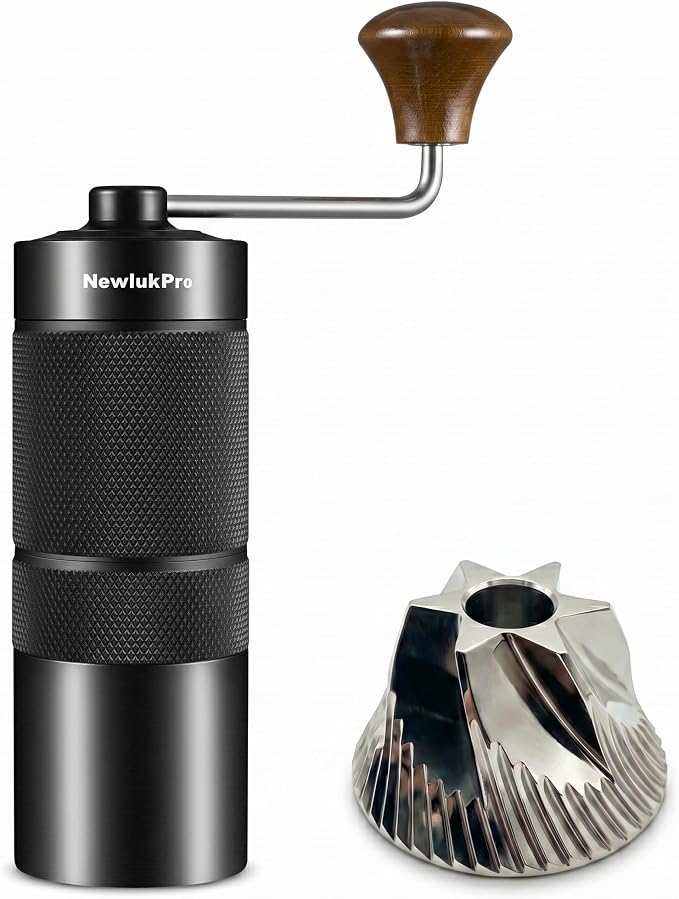
- All-Round Manual Coffee Grinder: NewlukPro coffee grinder was constructed with durable aluminum alloy.
- Professional Grade Conical Burr: Our Manual coffee bean grinder delivers better grinding effect than.
- Convenient Daily Use: Our Espresso hand grinder is convenient for daily use and easy to carry around. Has.
- Detachable and Easy to Use: Our burr coffee grinder is easy to take apart without the need for tools. Use.
CEVING Mini Manual Coffee Grinder With 40 Adjustable Settings, Black | Portable Hand Coffee Bean Mill with Ceramic Conical Burrs
The CEVING Mini Manual Coffee Grinder stands out for its exceptional portability and fine-tuned control. According to manufacturer data, it offers an impressive 40 precise grind settings, a significant advantage for dialing in specific brew methods. Weighing only 325g and designed with compact dimensions, it is an excellent companion for camping, travel, or any on-the-go coffee needs. The use of ceramic conical burrs is a key feature, as ceramic burrs are known for generating less heat during grinding, which helps preserve the delicate flavors of your coffee beans. They also provide a uniform grind, important for consistent extraction across various brewing methods. This grinder is a practical option for those prioritizing portability and precise, heat-sensitive grinding.

- Unlike traditional grinders with internal adjustments, our manual coffee grinder offers 40 precise.
- Weighing only 325g and measuring 6.7x2.3x7.4in, it's ideal for camping, travel, RVs, patios, or the.
- Ceramic burrs provide a more uniform grind and generate less heat than stainless steel or blade burrs.
- With a 30g capacity, this grinder allows you to grind enough coffee beans in one go, making your coffee.
long term Cost of Ownership and Maintenance
Manual coffee grinders are generally low-maintenance, but a few practices will extend their life and maintain grind quality.
Cleaning Frequency and Method
Regular cleaning is essential to prevent oil buildup and old coffee particles from affecting flavor. Plan to clean your grinder every 1-2 weeks, or more often if you grind dark roast or oily beans. Disassembly for a thorough clean is often required, but some quick cleaning methods exist. Learn more about maintaining your equipment with resources like Quick Coffee Grinder Cleaning: No Disassembly Required.
Burr Replacement
While ceramic and steel burrs are durable, they can wear down over many years of heavy use. Some high end manual grinders offer replaceable burr sets. For most home users, burr replacement will not be a concern for a very long time, if at all.
Lubrication of Moving Parts
The crank mechanism and central shaft may benefit from occasional light lubrication with food-grade lubricant, though this is rarely needed for well designed modern grinders. Always consult the manufacturer's instructions.
A manual coffee grinder is a simple yet powerful tool for elevating your coffee experience. By focusing on burr material, adjustment mechanisms, and overall build quality, you can select a grinder that provides consistent, delicious results for years to come.